

Al Awali Real Estate executive Hisham Al Sharif says the ideal home is not the largest or most expensive, but one that meets a family’s needs and supports long-term quality of life.
Choosing a home in Saudi Arabia is no longer just about price, location or floor space. As cities evolve, housing options diversify and family lifestyles change, buyers are increasingly looking at how well a property supports their daily routines, financial circumstances and future needs.
Market trends reflect this shift. According to JLL’s first-quarter 2026 report, buyers are showing greater interest in residential communities that balance affordability with quality amenities and services. A 2026 Knight Frank survey of prospective buyers, including residents and international investors interested in the Saudi market, identified family-friendly environments (28%), safety and security (25%), and green spaces (24%) among the leading factors influencing residential community appeal.
For Hisham Al Sharif, Head of Development and Board Member at Al Awali Real Estate, choosing the right home begins with understanding what a family actually needs.
“A home is not simply a space we occupy. It is an environment where we live our daily lives. A good housing decision starts with understanding a family’s real needs, rather than being impressed by a larger space or a long list of features they may never use,” he said.
Location and Design Matter More Than Size
A good location should be assessed by how effectively it supports everyday life, Al Sharif explained. Proximity to schools, healthcare facilities, major roads and workplaces can reduce commuting time and ease daily pressures. Infrastructure quality, safety and access to amenities also shape the long-term residential experience.
He advises prospective buyers to visit neighbourhoods at different times of the day and assess actual travel times instead of relying solely on distances shown on maps.
Inside the home, efficient design can be more valuable than additional square metres. Room layouts, privacy, natural lighting, ventilation, storage and ease of movement all contribute to a property’s usability.
“A smaller unit with a smarter design can provide a better living experience than a larger one with underused spaces. The measure is not simply the number of square metres, but the benefit they deliver to the family,” Al Sharif said.
Climate and operating efficiency are also important considerations in Saudi Arabia. Thermal insulation, window quality, air-conditioning systems and suitable building materials influence comfort, energy consumption and maintenance requirements.
Buyers should therefore look beyond the purchase price and consider financing commitments, fees, operating expenses and future maintenance costs. Evaluating the total cost of ownership can help prevent a property from becoming a financial burden.

Building Homes Around Real Needs
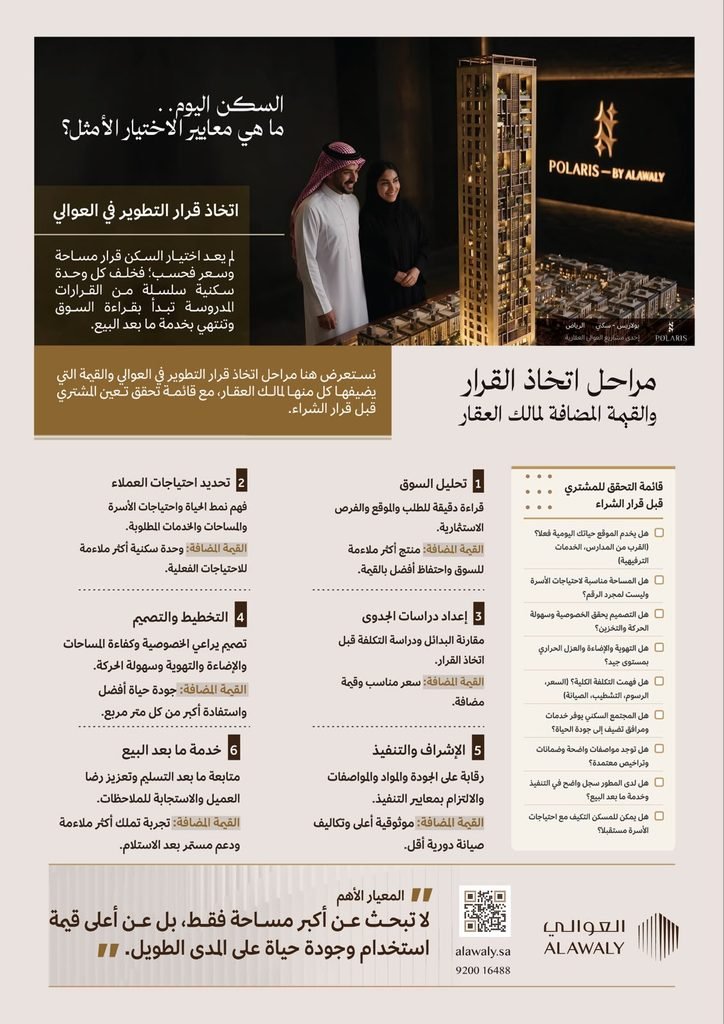
From a property development perspective, Al Sharif said creating suitable housing begins well before construction. At Al Awali Real Estate, the development process follows six interconnected stages: market analysis, identifying customer needs, feasibility studies, planning and design, construction supervision, and after-sales services.
The approach begins by understanding demand and the needs of target customers before deciding on a property’s specifications. These findings then inform design and construction decisions, helping balance housing quality with economic feasibility.
“The goal is not to add features that increase costs without a clear purpose, but to direct investment towards the elements that make a real difference to residents’ experiences,” he explained.
Al Awali’s approach focuses on residential products and communities that combine functionality, quality and sustainability. This includes considering not only individual housing units but also their relationship with shared facilities, common spaces, privacy and movement throughout the development.
Al Sharif also stressed that quality must extend beyond a project’s appearance. Construction standards, execution quality, clear specifications and reliable after-sales services are essential to maintaining residents’ confidence.
“Development quality is not proven by attractive façades alone. It depends on construction efficiency, clear specifications, compliance with building standards and a well-defined after-sales service system. The relationship between a developer and a customer should not end when the keys are handed over,” he said.
A Practical Checklist for Homebuyers
Al Sharif advises prospective homeowners to look beyond marketing materials and advertised prices before making a decision. Buyers should review floor plans and technical specifications, verify licences and warranties, understand contractual obligations and seek a professional property inspection when necessary.
They should also consider whether a home can adapt to changing family circumstances over time. Comparing properties based on overall costs and practical usability, rather than price per square metre alone, can lead to more informed decisions.
As Saudi Arabia’s residential market continues to develop, Al Sharif believes both developers and buyers have a role in improving housing outcomes. Developers must create properties based on genuine needs, while buyers should evaluate their options against clear and practical criteria.
“The right home is not necessarily the most luxurious or expensive. It is the one that provides a family with comfort, safety and efficiency, while remaining suitable as the years pass,” he said. “When quality of life becomes the starting point for both development and purchasing decisions, we are not simply building housing units. We are creating more sustainable communities.”