
The second edition of the Public Art Abu Dhabi Biennial has opened across Abu Dhabi, presenting 22 artworks by 21 Emirati and international artists and collectives. Organised by the Department of Culture and Tourism – Abu Dhabi (DCT Abu Dhabi), the biennial brings together 20 new commissions across public spaces in Abu Dhabi and Al Ain.
Titled Home: A Glossary for a Communal Sense of Place, the biennial is led by artistic director Elvira Dyangani Ose. Following its opening in Al Ain on October 23, the Abu Dhabi chapter opened on November 15, extending the exhibition to four locations across the capital: Souq Al Mina, Mina Zayed (MiZa), Hidd Al Saadiyat Promenade and the park between Zayed National Museum and Louvre Abu Dhabi.
In Al Ain, the artworks are presented at Al Qattara Oasis and Al Towayya Roundabout. The exhibition brings art into a range of settings, including historic marketplaces, working ports, protected beaches, museum districts and a UNESCO World Heritage Site. All artworks are free to visit until February 15, 2027.
Exploring the Meaning of Home
The second edition approaches home as a shared and evolving experience rather than a fixed geographical location. Through site-specific commissions, research-led projects and public encounters, the biennial invites visitors to consider how communities create a sense of belonging through language, memory, traditions and everyday practices.
Each artwork responds to the social, material and environmental characteristics of its location. These include the boatyards and fishing traditions around Abu Dhabi’s port, as well as the irrigation channels and agricultural heritage of Al Ain’s oasis.
Souq Al Mina: Art Along the Waterfront
At Souq Al Mina, one of Abu Dhabi’s oldest port districts, ten artists and collectives present 11 artworks across the marketplace and its waterfront.
Italian artist Marinella Senatore presents I Contain Multitudes (2026), a large-scale light installation inspired by traditional Italian luminaria structures used in civic and religious celebrations. The work reimagines these structures as a space for gathering.
Colombian artist Iván Argote presents two works. The Other, Me & The Others (2026) is a monumental circular seesaw designed around collective balance, while Figurines (2026) transforms enlarged archaeological objects from Abu Dhabi sites, including Umm Al Nar and Jebel Hafeet, into an interactive landscape.
French artist Laure Prouvost’s Landed Here To Sea You With… (2023) features an octopus carrying a flag with the words “Ideally You Would Sea Where to Go”. Spanish artist Elena del Rivero presents Letter to the Mother (2026), a bilingual neon installation inspired by the saying “Paradise lies beneath the feet of mothers”. The work runs along the Rocks, with the water providing its backdrop.
Argentine artist Mercedes Azpilicueta’s Montipora foliosa (2026), named after a coral species, connects the Arabian Gulf with Argentina’s San Jorge Gulf through their shared marine ecosystems.
Mexican artist Vica Pacheco presents OO! (Oven-Organ) (2026), which transforms the steam whistle of a traditional Mexican street food cart into a musical installation featuring three sounding ovens. The work is activated through performances and communal meals.
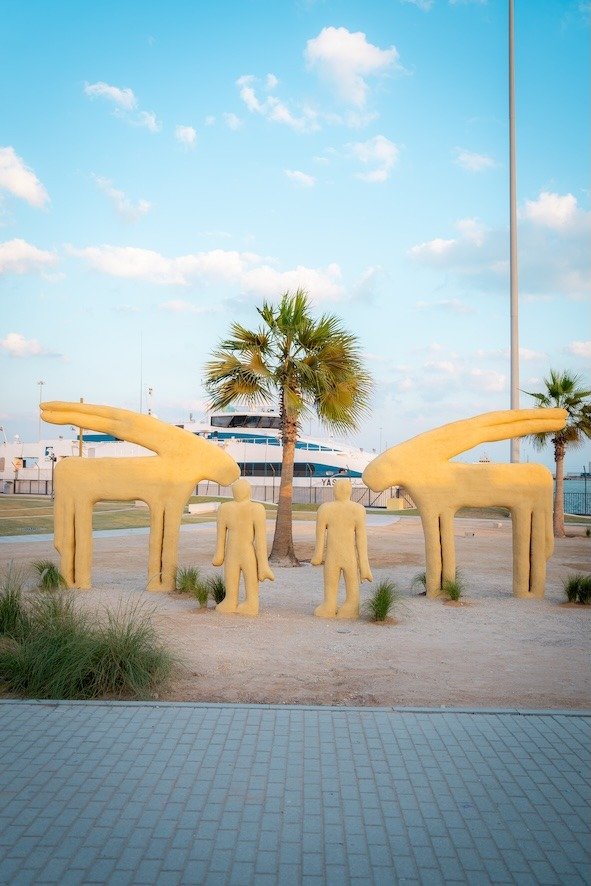
Ghanaian artist Serge Attukwei Clottey’s Wole Worhe (We Know Each Other) (2026) uses repurposed yellow Kufuor gallons along the breakwater, with a central viewing platform facing the sea and historic port.
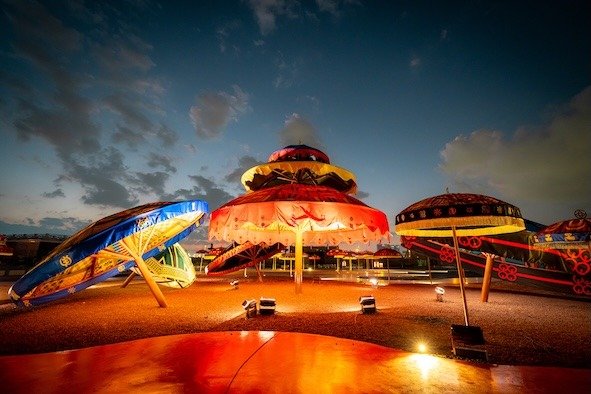
The Kumasi-based collective blaxTARLINES presents AGORA: A Dance of Umbrella Forests (2026), bringing Ghanaian and Emirati traditions of leadership into dialogue through the form of the Ghanaian royal umbrella.
French artist Céleste Boursier-Mougenot’s clinamen (v.13) (1997–2026) features white porcelain bowls drifting across three water-filled basins, creating an evolving sound composition shaped by chance.
Another major work, Ghanaian artist Ibrahim Mahama’s Zilijifa II (2026), will go on view at Souq Al Mina in December. The installation features a full-scale decommissioned diesel locomotive connected to the artist’s long-term engagement with Ghana’s railway system.
Mina Zayed: Exploring Maritime Heritage
At Mina Zayed, Abu Dhabi’s first commercial port, four artworks respond to the area’s maritime history and working waterfront.
Jamaican-born, New York-based artist Nari Ward presents Ground Break Duty (2026), featuring the open rebar framework of a dhow raised from a copper ground and surrounded by fishing nets and locally collected objects.
Emirati artist Khalid Al Banna’s Gargour (2026) reinterprets the traditional Emirati fishing trap using red, orange, yellow, green and blue. The installation places the trap’s inner space at the centre of its concept.
On the MiZa Observation Deck, Emirati artist Shama Al Hamed presents I Breathe Through the City (2026), which brings Abu Dhabi’s hidden ventilation networks into public view. The installation transforms the deck into an architectural drawing that appears to inhale and exhale.
Lebanese artist Akram Zaatari’s Above and Below (2026) features an olive tree whose roots surround an ancient sarcophagus. The work invites visitors to reconsider how heritage is approached and understood.
Saadiyat Island: Art Along the Coastline
On Saadiyat Island, the biennial moves from the port to the coastline and Abu Dhabi’s cultural district.
At Hidd Al Saadiyat Promenade, French artist Jean-Marie Appriou presents Horizons (2023), an aluminium vessel carrying two astronauts and inspired by the solar boats of ancient Egypt.
The work is displayed alongside Plotting Rest (2026) by Canadian-French artist Kapwani Kiwanga. The installation features a pavilion made of stone columns and woven palm leaves, with an interlocking triangular roof designed to filter light, wind and rain. The promenade is located beside protected beaches where hawksbill sea turtles nest.
In the park between Zayed National Museum and Louvre Abu Dhabi, British-Nigerian artist Yinka Shonibare presents Wind Sculpture (TG) III (2026). The work takes the form of a billowing sail, featuring a hand-painted surface that combines the artist’s signature Dutch wax patterns with Emirati Sadu motifs.
Al Ain: Connecting Art with Oasis Heritage
The Al Ain chapter, which opened on October 23, continues at Al Qattara Oasis with works by M’barek Bouhchichi, Reena Saini Kallat and Asunción Molinos Gordo.
At Al Towayya Roundabout, Al Ain-born Emirati artist Roudhah Al Mazrouei presents Tassa (2026). The work reimagines the traditional Emirati gold headpiece as an expansive public landscape measuring 80 metres in diameter.
Artistic Director on the Biennial’s Theme
Elvira Dyangani Ose, Artistic Director of the Public Art Abu Dhabi Biennial 2026–27, said the exhibition explores the many meanings associated with the idea of home.
“Home is one of the most used terms in any language, and yet many aspects of it often go unexamined. It tends to be assumed rather than defined – invoked as though its meaning were self-evident, shared, stable. Yet the more precisely one tries to hold it, the more its meanings multiply. Home is not only a location. It is a practice, a concept, a space: felt before it is understood, carried in the body before it is articulated in language,” she said.
She explained that the biennial uses a glossary as its organising structure, offering a collection of ideas rather than a fixed definition of home.
“Each entry is a starting point rather than an endpoint; it is an invitation to think through them, to reinterpret them, for the viewers to complete. Home is presented as a constellation of trajectories, as something collectively generated through language, memory, ritual, and everyday practice,” she added.
The artworks draw on the social and environmental characteristics of Abu Dhabi, its resources and its wider region. They also explore everyday practices, family sayings, neighbourhood traditions, agriculture, crafts and the passing down of cultural knowledge between generations.
Parallel Programmes Across Abu Dhabi
Alongside the main exhibition, the biennial includes a series of parallel programmes across the city.
These include NOMAD Abu Dhabi: A Memory of Shade by Objects of Common Interest at ERTH, running from November 15, 2026, to February 15, 2027.
At Old Abu Dhabi Airport, Terminal 1, Robin Rhode will present his mural and performance Paper Planes on November 18. At MiZa, the Jidran Mural Festival, developed with The Workshop, will bring local and international artists together to create large-scale murals.
The Cultural Foundation Outdoor Screen will feature Nujoom Alghanem’s film In Search of the Remaining Moments (2025). Meanwhile, Agatha Gothe-Snape’s The Network of Answers, led by Guggenheim Abu Dhabi, will move from Al Qattara Oasis to Souq Al Mina, where it will be on view from November 15 to December 1, 2026.
The biennial’s public programme of talks, performances, workshops and tours will be announced separately.
Building on the First Edition
The second edition builds on the inaugural Public Art Abu Dhabi Biennial, Public Matter (2024–25), which featured site-specific commissions by artists from the UAE and around the world. Several works from the first edition have since been acquired or retained as long-term installations, becoming part of the Public Art Abu Dhabi Collection.
The 2026–27 edition continues the initiative’s focus on bringing contemporary art into public spaces and creating opportunities for audiences to engage with artworks in their everyday surroundings.
The Public Art Abu Dhabi Biennial is open to the public and free to visit. The Al Ain chapter runs from October 23, 2026, to February 15, 2027, while the Abu Dhabi chapter runs from November 15, 2026, to February 15, 2027.